Hours, prices and access verified by the Veuve Clicquot Tours team — last checked 2026-09-24.
Every visit to Veuve Clicquot takes you down into its crayères, the old chalk
quarries on the edge of Reims where its bottles age. You choose the visit by its length and
by what you taste at the end. If you are pricing Veuve Clicquot tickets, the table below is
the house's own list, before any tour fare.
What the crayères are, and why wine ages there
A crayère is a chalk pit, dug as a quarry and later reused as a cellar. Veuve Clicquot
settled into 482 of them in 1909, on the outskirts of Reims. Its production site and its
visit centre stand there today, so you walk down from the reception into the chalk.
The chalk keeps the wine at a constant 10 to 12 °C, away from light and vibration. That
steady cold is what lets a bottle rest for years on its yeast. You feel it the moment you
reach the bottom of the stairs, whatever the month outside.
Crayères:
482, taken over by the house in 1909
Temperature:
a constant 10 to 12 °C, by the house's own figure
UNESCO:
listed on 5 July 2015, with the whole Saint-Nicaise hill
Region-wide:
champagne.fr counts 370 crayères in Champagne and 25 km of
galleries under the Saint-Nicaise hill
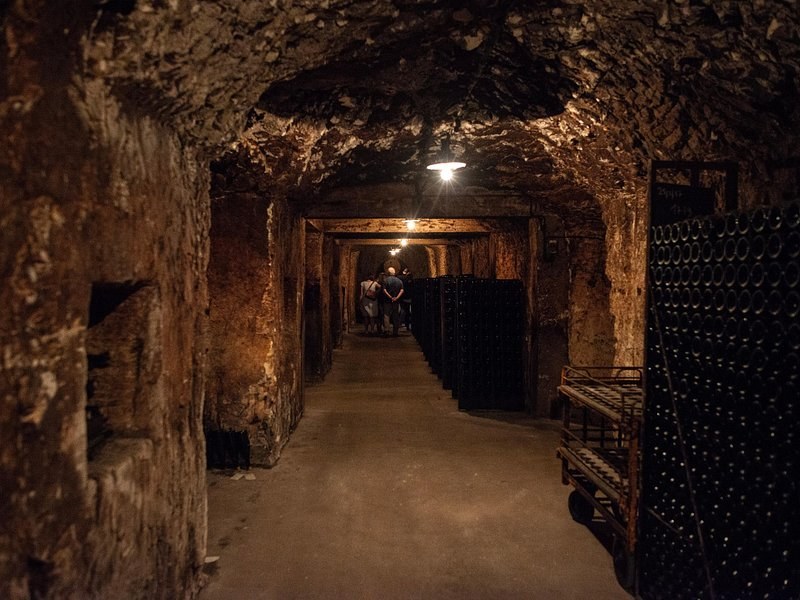
A long chalk gallery under a single lamp, bottle stacks along its walls
The house's cellar tours, side by side
Each visit is a guided cellar tour with a tasting, led by a house guide. They differ in
length, in price and in what the tasting is built around. The prices are the house's own,
in euros, per person, as it publishes them.
The house's cellar tour
Length
Per person
Built around
Private?
Brut Yellow Label, the birth of a style
1 hour
EUR 36
The house's signature blend
No
The art of blended rosé champagne
1 hour
EUR 60
The rosé method of 1818
No
One Quality, The Finest
1 hour 30
EUR 80
The house's motto
Can be privatised
The art of aging
2 hours
EUR 160
Time on the lees
Can be privatised
La Grande Dame, the Maison's showcase of excellence
4 hours
EUR 260
The prestige cuvée
Can be privatised
For a first visit, the one-hour Yellow Label tour shows you the chalk and the house style.
If you already know the wine, the two-hour visit spends longer on ageing, and the four-hour
one is built around La Grande Dame. You book a time slot on the house's website, and opening
days change through the year, as the visitor guide sets out.
Rather have the cellar ticket booked for you?
The shared days from Reims station carry the house ticket, a family grower and lunch in one fare, with a guide all day.
From press to riddling table: how the wine is made
The cellar tour shows you the last and slowest stages. The house describes the whole
cycle on its own vine-to-wine page, and it helps to know it before you go down.
1
Pressing
Whole bunches go into 29 presses across six centres. The house keeps mostly the first juice, the cuvée.
2
Fermenting
The must settles for 15 hours, then ferments for eight to ten days at 18 °C into a still wine.
3
Blending
A committee of eight oenologists tastes more than 1,000 wines from November to March.
4
Resting
Bottled with yeast, the wine turns sparkling, then ages on its lees in the chalk.
5
Riddling
Turns of a quarter, an eighth or a sixteenth bring the sediment into the neck.
After riddling, the neck is chilled to minus 26 °C and the frozen plug of yeast is forced
out. That step is disgorging. A small dose of sugar follows: 9 grams a litre for the Brut
Yellow Label. The cork is held by a wire muzzle and a metal cap that carries an image of Madame
Clicquot. Look for it on the bottle you taste.
How long the wines rest underground
The time in the chalk is where most of the house's patience goes. Every non-vintage wine
rests at least 30 months, which the house calls twice the standard. Its vintage wines rest
at least five years, and La Grande Dame at least seven.
Most of the blend is not even from the same year. The Brut Yellow Label draws on about
fifty crus, and 25 to 50% of it is reserve wine. The house keeps 400 reserve wines from 17
different years for that. So the bottle you taste in the tasting room carries several
harvests at once.
Riddling: the table Madame Clicquot devised
In 1816 Madame Clicquot devised the first riddling table, the ancestor of the rack, to get
clear wine. Every champagne house later took it up. Riddling slowly tips each bottle neck
down, with small daily turns, so the dead yeast gathers against the cork.
Today the house riddles most bottles semi-automatically. Only La Grande Dame and the large
formats are still turned by hand. The house treats the riddler's skill as heritage it wants
to pass on, so you may see the racks on your way through the galleries.
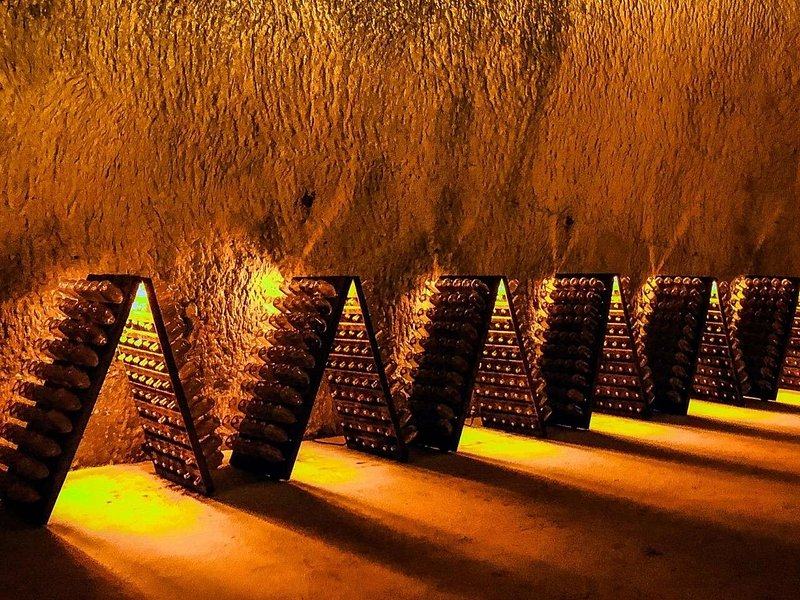
Riddling racks of bottles lit from below along a rough chalk gallery
Going down: stairs, cold and access
A cellar tour means stairs and cool air. Plan for both, and you will enjoy the
chalk far more.
Stairs: you walk down into the chalk and back up on foot. Wear
shoes with grip, and take the handrail after the tasting.
Cold: 10 to 12 °C all year. Carry a jumper or a light jacket, even in
summer.
Wheelchairs: the house says its visit, boutique and café are accessible
to people with reduced mobility, if you mention it when you book.
Strollers: there is no storage for them, so on request at reception
you take them down into the cellars with you.
Dogs: no animals anywhere in the visit centre, because of its
food-safety certification.
Children: the house sets no minimum age. The tour operators set
their own, from no children under 4 to adults only.
Among the day tours, a few listings say they suit wheelchair users, one of them a
private day from Reims station. If you need step-free help, ask the operator what the
vehicle and the second stop allow before you book.
Private cellar tours and private events
The three longer visits, from EUR 80 up, can be privatised for your party. You arrange
that through the house's private-tours desk, on +33 (0)3 26 89 42 64, rather than the public
booking page.
For a group, the house also hosts private events. At the Saint-Pétersbourg visit centre
it takes 25 to 130 people, from EUR 210 per person. At the Manoir de Verzy, its house in the
vineyards, it takes 5 to 30, from EUR 420.
A private day tour is a different thing. It buys you your own car, a chauffeur or a guide,
and a second stop. The cellar tour itself is still led by a house guide. So if you want the cellars alone, you ask the house; if you want the day alone,
you book a private tour.
Want the whole day to yourselves?
The private days collect you in Reims or at a Paris hotel, with the cellar ticket in the fare and the choice of a second house or a grower.
Most of the day tours carry the house ticket inside the fare. A few do not promise
Veuve Clicquot at all. Here is how to tell them apart before you book.
Shared from Reims: $375 to $382 per person, with the
house ticket, a family grower and lunch. They meet at Reims station at 9:20 am.
Private from Reims: $520 to $838 per
person, with the ticket and a second producer.
From Paris: $521 to $996 per person for a
private day that names the house, with a hotel pickup.
House may vary: $376 to $1,216 per person for a
Champagne day that visits a famous house by availability. It may or may not be Veuve
Clicquot, and one of them leaves the house fees out of the fare.
A couple of fares that do name the house still say the visit depends on availability on
your date. Their cards say "if available", so you know before you pay. Compare the starts on
Veuve Clicquot tours from Reims and Veuve Clicquot tours from Paris.
Questions about the cellars
How long is a Veuve Clicquot cellar tour?
The shortest runs one hour and the longest four. In between sit a 90-minute and a two-hour visit. All of them end with a tasting.
How cold are the Veuve Clicquot cellars?
The house keeps its wines at a constant 10 to 12 °C in the chalk. Bring a warm layer, even in August.
Can I take a wheelchair into the cellars?
Yes, on request at reception, and the house asks you to mention reduced mobility when you book. It has no storage for wheelchairs or strollers, which is why they go down with you.
Can children join a cellar tour?
The house publishes no minimum age for its cellar tours. Each tour operator sets its own rule, so read the one on the listing you want.
Can I book a cellar tour for my party only?
Yes. The three longer visits, at EUR 80, EUR 160 and EUR 260, can be privatised through the house's private-tours desk. A private day tour also gets you your own car, but the cellar visit itself is led by a house guide.
Are the Veuve Clicquot cellars a UNESCO site?
Yes. On 5 July 2015 UNESCO listed the Saint-Nicaise hill in Reims and its crayères, the house's included. They form one of three parts of the Champagne Hillsides, Houses and Cellars property.
The lowest private fare from Paris that names the house: a chauffeur from your door, the house's English-guided cellar tour and time in Reims. Meals are yours.
Your own guide from Reims station: the house's tickets, the cathedral, a walk through the city and a boutique producer at Rilly-la-Montagne. Marked wheelchair accessible.
The cellar tours, prices, access rules and production figures come from the house's own
visit and vine-to-wine pages. The UNESCO dates come from UNESCO and champagne.fr, and the
tour fares from each listing.