Hours, prices and access verified by the Veuve Clicquot Tours team — last checked 2026-09-24.
The wine you taste in the Reims cellars starts in vineyards across Champagne,
and most day tours give you an hour or two among them. This page shows you where the grapes
come from, what happens at the house's manor at Verzy, and which villages each
veuve clicquot champagne tour drives you through.
About fifty crus in one Yellow Label
The house does not make its signature wine from one slope. The Brut Yellow Label is
blended from about fifty different crus, and 25 to 50% of it is reserve wine from earlier
years. Each year the tasting committee tastes more than 1,000 still wines to build it.
The grapes go to six pressing centres and 29 presses. The house presses each grape variety,
each cru and each fraction apart, so the character of each place survives until blending.
It publishes no figure for its own vineyard area, so we give none.
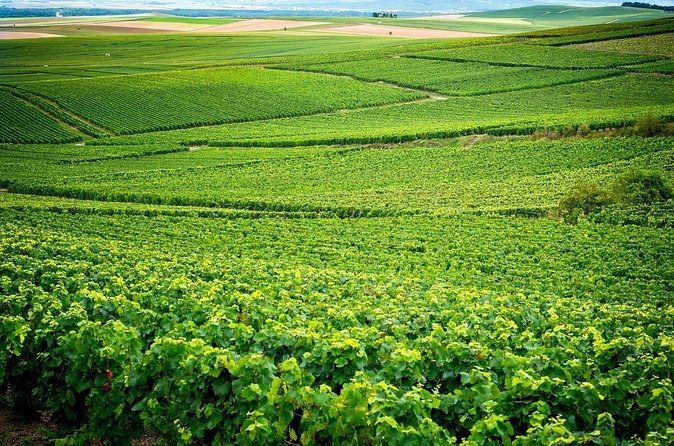
Green vine rows rolling to the horizon under a pale sky
The Champagne vineyard in numbers
The appellation is small enough to cross in a morning and varied enough to fill a day.
These are the figures the Union des Maisons de Champagne publishes.
Area:
about 34,000 hectares of vines, some 150 km east of Paris
Crus:
319 villages, in four areas: the Montagne de Reims, the Vallée de la
Marne, the Côte des Blancs and the Côte des Bar
Grand cru:
17 villages
Premier cru:
42 villages
Altitude:
vines grow between 90 and 300 metres
The ranks are old. A scale of crus was first set in 1911, and a decree of 1952 kept
"grand cru" for villages rated 100%. The scale itself was scrapped in 2010, but the villages
kept their titles. So a village's rank tells you its history, not the taste of your glass.
The Manoir de Verzy, the house in the vines
The Manoir de Verzy is where the house receives guests among its vineyards. It stands at
12 rue Ernest Graingault, 51380 Verzy, with free parking, about 25 minutes by car from the
Champagne-Ardenne TGV station.
What it hosts: the summer picnic, the harvest luncheon and private
events.
Private events: 5 to 30 people, from EUR 420 per person.
Getting there: by car or taxi. None of the day tours here lists the
manor as a stop.
The picnic and the harvest luncheon
The house runs two dated events at the manor. Both are booked with the house, not through
a tour, and both 2026 dates are now behind us.
At the Manoir de Verzy
2026 dates
Adult price
Places
Le Picnic by Veuve Clicquot
5 June to 31 August, Friday to Sunday, plus 4 and 5 September (season ended)
EUR 88
100 a date
Harvest luncheon
12 and 19 September (both passed)
EUR 132
130
Private event
On request
From EUR 420
5 to 30 people
The picnic pours a glass of Brut Rosé and a half bottle of Brut Yellow Label for each
guest. Young people aged 10 to 17 paid EUR 55, children under 10 EUR 32, and under-3s went
free. It runs in French and English, and moves into a tent in bad weather.
The harvest luncheon charged EUR 72 for ages 3 to 17. If you want either next year, watch
the house's pages in spring, because each date takes only 100 or 130 guests.
Villages on the tour routes
These are the villages the tour listings name, and what each tour does there. The cru
ranks are the listings' own words.
Verzenay and Mailly
France Intense's shared day from Reims station drives through the Montagne de Reims vineyards at Verzenay and Mailly. Its listing calls them grand cru villages.
Rilly-la-Montagne
France Intense and Uncork each stop at a family producer here for 1.5 hours, and Le Tour de Vigne's private day for 1 hour 45.
Ludes
Le Tour de Vigne's private day from Paris walks you through the Ludes vineyards for 30 minutes, next to its Rilly winemaker.
Verzy
The house's manor stands here. The tours pass through the Montagne de Reims, but the manor opens only for its own events.
Hautvillers
The most-visited village on these routes. Clewel's days stop at its viewpoint and the Saint-Sindulphe church, and À La Française gives it an hour.
Bouzy
No tour stops here, but it belongs in the story. Madame Clicquot blended red wine from Bouzy into champagne for her first blended rosé in 1818.
Want an hour in the vines as well as the cellars?
The Reims days pair the house with a family grower in the Montagne de Reims, and most put lunch in the fare.
Hautvillers and the man who did not invent champagne
Hautvillers sits on a slope above the Marne, and its view is why tours stop. Its historic
vineyards are one of the three parts of the UNESCO listing, with Aÿ and Mareuil-sur-Aÿ.
Dom Pierre Pérignon came to the Benedictine abbey here in 1668, aged 29, and ran its
estate for 47 years until his death in 1715. His tomb is in the Saint-Sindulphe church, the
one the Clewel days stop at.
He is often called the man who invented champagne. He did not: champagne.fr says plainly
that champagne was not invented by anyone. The wine grew out of many hands and many cellars,
Madame Clicquot's among them. So when a guide tells the story, enjoy it as a legend.
The harvest, and when you can see it
The picking date moves with the weather, and each year the Comité Champagne sets it
village by village. In 2026 it set the first picking at Montgueux on 8 August, and most
Marne villages between 12 and 17 August. So in 2026 the harvest was an August event.
Madame Clicquot's own famous year was a harvest: the 1811 Comet vintage, named for the comet
that flew over the region. If you want to see pickers, come in August, and ask the
operator whether the day's grower is picking.
Questions about the vineyards
Where do Veuve Clicquot's grapes come from?
From across Champagne: the Brut Yellow Label is blended from about fifty crus. The house presses them in six centres, and keeps each grape variety and cru apart until blending.
What is the Manoir de Verzy?
It is the house's manor in the vineyards at Verzy, 25 minutes by car from the Champagne-Ardenne TGV station. It hosts the summer picnic, the harvest luncheon and private events.
When is the Veuve Clicquot picnic?
In 2026 it ran from 5 June to 31 August, Friday to Sunday, plus 4 and 5 September. That season has ended, and the house has not yet published the next one.
Did Dom Pérignon invent champagne?
No. champagne.fr says champagne was not invented by anyone. Dom Pérignon was the cellarer of the Hautvillers abbey, and his tomb is in its church.
When is the grape harvest in Champagne?
It moves every year. In 2026 the Comité Champagne opened the first picking on 8 August, and most Marne villages between 12 and 17 August.
Four glasses at the house, the cathedral, lunch, the vineyards of Verzenay and Mailly and a family estate, back at Reims station at 5:45 pm. Tuesday, Thursday or Saturday.
A wine-certified guide from your Paris door: a family winemaker at Rilly-la-Montagne, the Ludes vineyards, a lunch table booked in Reims, then over two hours at the house.
Meet at the Reims station tourist office at 9:20 am, or Épernay's at 8:30 am, for the house's cellars, Hautvillers, lunch at a family winery and nine tastings in all. Eight people at most.
The blending and pressing figures come from the house's vine-to-wine page, and the Verzy
events from its own event pages. The appellation figures come from the Union des Maisons de
Champagne and champagne.fr, and Dom Pérignon's dates from the Hautvillers tourist office.