Veuve Clicquot Facts: 1772, a Riddling Table and 47 Baltic Bottles
The short answer. Philippe Clicquot founded the house in 1772. His son's widow took it over in 1805 and gave it three firsts, by the house's own account: the first known vintage champagne, the first riddling table and the first blended rosé. The yellow label came in 1877, and 47 of its bottles were found in the Baltic in 2010.
The dates that made the house
These come from the house's own timeline. Keep them in mind on a cellar tour and you will follow the guide's story more easily.
| Year | What happened |
|---|---|
| 1772 | Philippe Clicquot founds the house |
| 1805 | His son François dies; the widow takes over within weeks |
| 1810 | The first known vintage champagne |
| 1811 | The Comet vintage |
| 1814 | 10,550 bottles of the 1811 shipped to Saint Petersburg |
| 1816 | The first riddling table |
| 1818 | The first blended rosé |
| 1877 | The yellow label trademark registered on 12 February |
| 1909 | The house settles into 482 crayères in Reims |
| 1972 | La Grande Dame launched for the 200th anniversary |
| 2010 | 47 bottles found in a Baltic shipwreck |
| 2015 | UNESCO lists the Saint-Nicaise hill and its crayères |
A widow at the head of the house
Barbe-Nicole Ponsardin married François Clicquot, the founder's son. He died in 1805, and within a few weeks his widow chose to run the business herself. That made her one of the first businesswomen of modern times, in the house's words, at a time when women were kept out of business. The house still trades on the French word for widow: veuve.
You will hear two ages for her in 1805, even on the house's own page. We leave the number out and keep the year. Her full story, and what she changed, is on the Clicquot house page. Planning your own veuve clicquot champagne tour? Start there.
The Comet vintage and the shipment to Russia
The harvest of 1811 was exceptional, and people credited the comet that crossed the sky that year. The house calls it the Comet vintage. In 1814 Madame Clicquot sent 10,550 bottles of it to Saint Petersburg, to be first on the scene when the Russian blockade on French goods was lifted. Her champagne was welcomed there, and the house notes that Pushkin, Chekhov and Gogol praised it. That is why the visit centre in Reims is called Saint-Pétersbourg today.
1810: the first known vintage
A vintage champagne is made from a single year's harvest, where most champagne blends several. The house's timeline puts the first recorded vintage in the region in 1810, under Madame Clicquot. Vintage wines still get the longest wait in the house's cellars short of La Grande Dame: at least five years before release.
The riddling table
In 1816 the house made the first riddling table. It held the bottles neck down at an angle, so the deposit from the second fermentation could slide into the neck and be taken out. The house says it guarantees a crystal-clear wine, and the process is still used today. The method spread across Champagne and survives in the racks you see underground. By then her peers had a name for her: la grande dame of Champagne. How it works on a visit is explained in the walk through the cellars.
Two myths, set straight
Two claims turn up on tour listings and in travel articles. Neither holds.
- "Madame Clicquot invented rosé champagne." She did not, and the house does not say she invented rosé champagne. Before her, rosé was coloured with a preparation made from elderberries. In 1818 she made the first blended rosé instead, adding red wine from Bouzy to her champagne.
- "Dom Pérignon invented champagne." Nobody invented champagne, as the Comité Champagne itself says. Dom Pérignon was the cellarer of the abbey at Hautvillers from 1668 until he died in 1715. His tomb is in the abbey church, and several tours from Reims stop there.
The yellow label
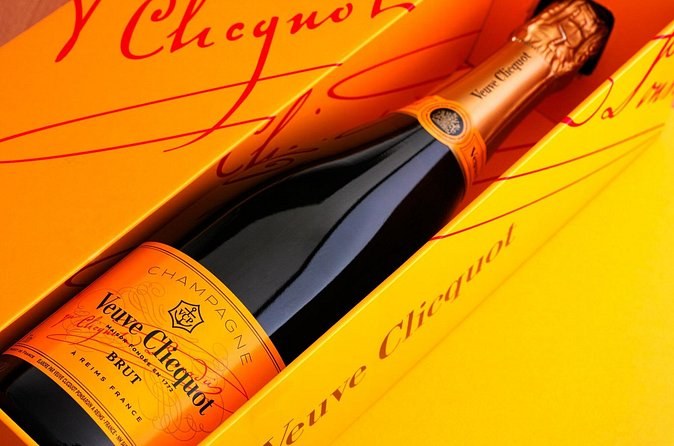
Yellow was an unusual colour for a wine label at the time. The house registered its "V. Clicquot P. Werlé" yellow label as a trademark on 12 February 1877. Customers began asking for the bottle by its colour, and the label became the house's calling card. The Brut Yellow Label you taste on the €36 cellar tour carries it today.
482 crayères and a UNESCO listing
In 1909 the house moved into 482 crayères, old chalk quarries on the edge of Reims. They are still its cellars and its production site, and the visit centre stands above them. In 2015 UNESCO listed the Saint-Nicaise hill in Reims, the house's crayères included, with the hillsides and cellars of Champagne. You can see them for yourself on any of the house's cellar tours.
La Grande Dame and the 200th anniversary
For its 200th anniversary in 1972, the house launched La Grande Dame, its prestige cuvée. The same year it created a business award for women, known today as Bold by Veuve Clicquot. Its longest cellar tour, four hours at €260, is built around La Grande Dame.
47 bottles from the Baltic
In July 2010 a shipwreck off Finland's Åland Islands, at the mouth of the Baltic, gave up its cargo of champagne. 47 of the bottles were Veuve Clicquot. The house says that, after almost two centuries on the seabed, their contents were extremely well preserved.
The rosé that sold out, and 250 years
The house launched its non-vintage rosé in Japan, during the cherry blossom season. It sold so well that the rest of the world had to wait until 2006 for its share. In 2022 the house marked its 250th anniversary with Solaire Culture, its first exhibition to travel the world. You can taste the rosé's ancestor, the 1818 blend, on the house's €60 rosé visit.
Who runs the cellars now
The house's motto is "Only one quality, the finest". It has had only eleven cellar masters in its history. The current one is Didier Mariotti. Veuve Clicquot joined Louis Vuitton in 1986, and LVMH was formed the following year, by the house's own history.
For more before you go:
- The house's cellar tours, prices and calendar are on the visitor guide.
- The crayères and what each visit shows are on the cellars page.
- Hautvillers and the villages the tours drive through are on the vineyards page.
To taste the history, the Grand Vintage day from Paris offers a tasting back to a 1990 vintage.
Tours that pour the house's history
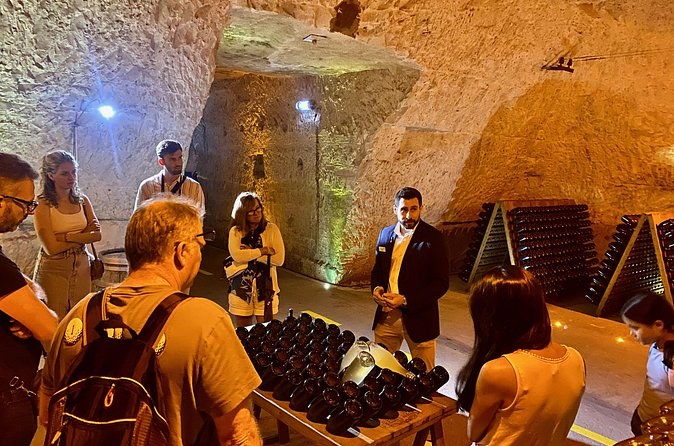
GRAND VINTAGE Taittinger Veuve Clicquot Cellars & Tastings trip
A second Reims house beside this one, with canapés at its tasting, plus the cathedral and free time in the city. A chauffeur drives you from Paris.
From $793 per person
Check Availability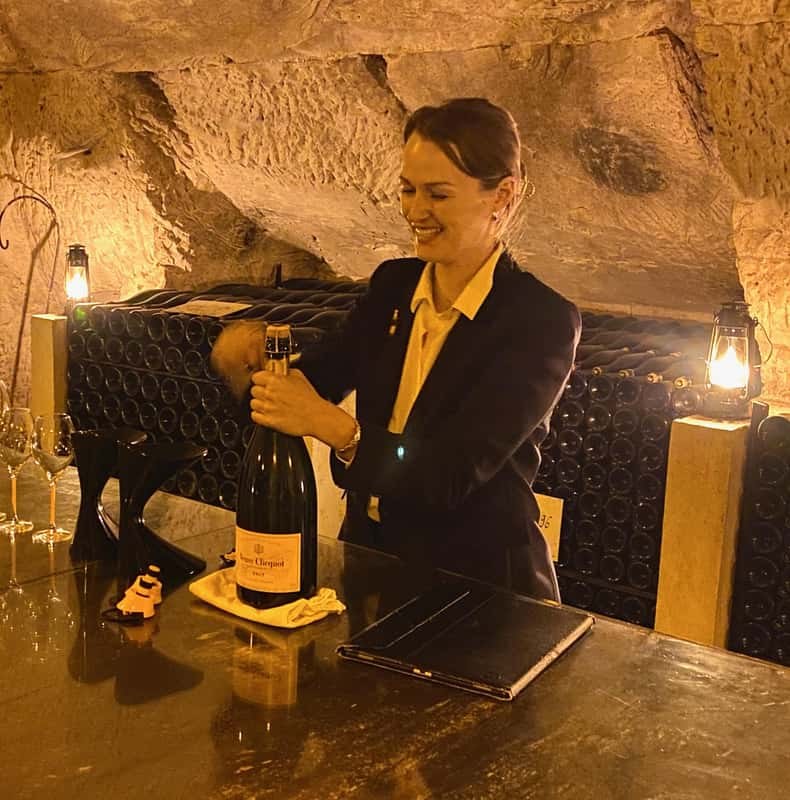
Veuve Clicquot Champagne Half day Private trip from Paris
The house's cellar tour at the tasting level you choose, Hautvillers and the cathedral, with a chauffeur from your Paris hotel and home by about 4 pm.
From $534 per person
Check AvailabilityNext: Find out what you can taste on the day on the cellars page. Every fare sits side by side on Veuve Clicquot Tours.